
Political Memes and Me

Political Memes and Me

It’s hard for me to appreciate political memes. Some say they’re a good way to start conversations, but they seem more like a pretentious way of affirming your own opinions. Those who share the meme think they’ve proven their brilliance, implying the message gives them the final word on the subject. The one who posts it feels pride, seeing themselves as sticking it to the idiots who disagree, walking away from social media with victory. In truth, there’s little to be impressed with. Someone came across a meme while scrolling online, confirmed the bias they already had, and then clicked Share. That’s all that happened. There was no research, nor any deep reflection on the topic. Just a feeling of righteousness as the sharer claims to drop a proverbial mic on the subject.

While these are cynical thoughts, this meme gave me a mixed bag of feelings: 
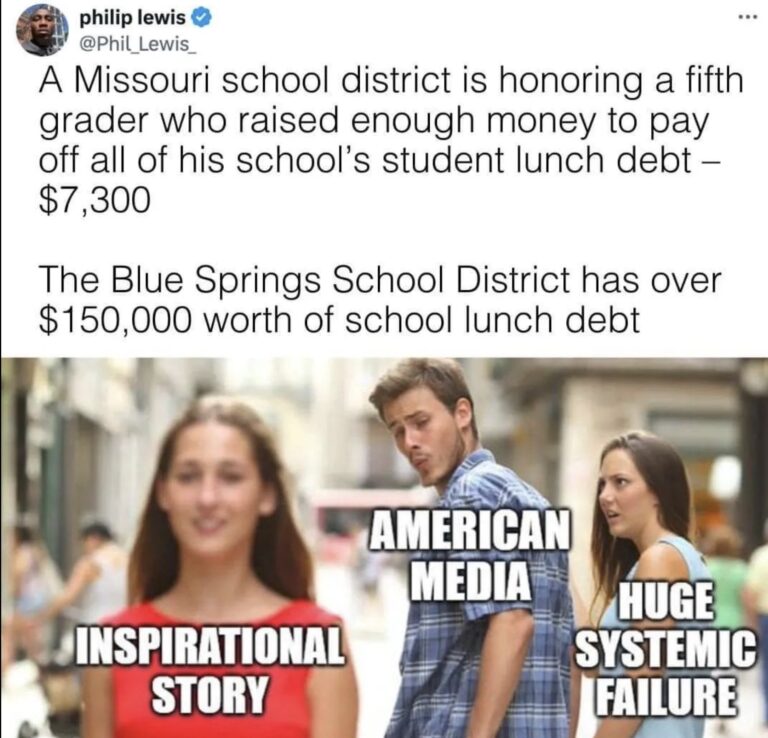
The post complains of the media’s lack of coverage on public school lunch debt in Missouri. This often-used image for memes is of a man gawking at an attractive woman while the girlfriend looks at him with disgust. In this case, the man represents “American Media”. The hot girl is “Inspirational Story”, and the girlfriend is “Huge Systemic Failure”. The argument is that American media doesn’t highlight societal problems, instead becoming distracted by individual acts of triumph. While it’s admirable to bring attention to such an obscure issue, the problems with the meme are hard to ignore.*

To their credit, the meme’s creator recognizes an unknown plight for families, and it’s a worthy topic to bring attention to. There are a hundred ways America is becoming more expensive as parents increase their debt from the simple need of not having their kids feel hungry in school. As a Minnesotan, it has been encouraging to see Vice Presidential candidate Tim Walz spearhead a national conversation on the topic. Minnesota has addressed the problem with a universal lunch program, and maybe the dialogue will lead other states to address it. With this, the suggestion that the media should report on it seems reasonable, for greater awareness and potential solutions.

At the same time, the meme’s critique of the media doesn’t jive with reality. Is it implying that American journalism doesn’t cover our problems? As an avid reader of current events, this appears absurd as the news gives us daily evidence to the contrary. The term “doom-scrolling” was coined for good reason. Constant news of injustice and heartache fill the pages of our media, showcasing the plethora of ways institutions have failed us.** Contrary to what the meme claims, the metaphorical boyfriend pays lots of attention to the girlfriend. She should feel confident in his unwavering devotion for her.

This isn’t to say that the media should stop showing us the warts of societies. Journalists should highlight them, and even if cynics like me roll my eyes at their apocalyptic tones, the public should know what’s going wrong. Still, I’d ask again: Who claims that the media doesn’t highlight these things? We are inundated with stories of crime, war, sex abuse, student debt, day care costs, climate change, housing shortages, poverty, etc, etc. So even if the media had yet to cover the specific issue of school lunch debt in Missouri, can we say with a straight face that journalists have failed us? It seems to be a silly suggestion.

Leaving that aside, the central claim of the meme is that journalists become distracted by singular stories of inspiration, bringing our gaze away from the problems. If this were true of media on a massive scale, then it might be a practice worth addressing. But two points come to mind:

1.    Media outlets have enough resources and common sense to pursue both the inspirational and public failures. It’s hard to reduce an entire organization of journalists and their resources to one boyfriend gawking at a stranger. The media can walk and chew gum at the same time, highlighting the mountains of suffering in the world while sharing some of the heartwarming tales.

2.    Couldn’t it be said that inspirational stories, like the kid raising money for student lunch debts, help to reveal the problems at hand? News is getting out that something bad has been happening to families in Missouri. In this case, the student’s fundraising caused both media fawning and the creation of the meme. Reporting on the good can still bring our attention toward the problem, showing us that news doesn’t have to exclusively showcase doom and gloom.

Even beyond this, we haven’t yet considered the positives of the media sharing inspirational stories. Just as we need to know the problems we face, we need to aspire to stories of charity and triumph. The successes of a government program. The offerings of communities. The stories of survival. The acts of forgiveness and philanthropy that will make the world better. Such reporting gives the public courage and inspiration to believe in what is possible. Telling us about the healing of a cancer patient doesn’t stop us from knowing about cancer, and we shouldn’t discourage the media from covering the story of the patient. Journalists should also be messengers of good tidings, along with all of the bad.

Funny enough, thinking about this meme has raised my general confidence in the media. As much as we complain about the biases and half-truths of their coverage, journalists will report on most of the things we should know. When subscribing to The New York Times in 2022, the first thing I read was a series of stories on the war starting in Ukraine. The level of detail they shared was remarkable, from political motivations to problems with military equipment. It was clear how much work and dedication the newspaper went through to pull the information together, to inform people like me. Sure, biases spring up in stories, and mistakes can always be made, but it’s hard to believe the media has a widespread practice of showing fluff stories over the ugly.

With all of this reflection on media, it’s amazing now to remember that it all came to me from a simple meme. Maybe I should cut memes some slack – to give them a chance to add to our conversations. Maybe memes are like people: Even if their views are nonsense, we can still learn something if we pay attention. The motivations of someone who shares the meme can be suspect, with trolling and arrogance always possible. And yet, the meme on student lunch debt gave me an awareness of the issue, and the chance to refine my thoughts on modern journalism. That’s not a bad job for an over-used image with a few short captions. Maybe, indeed, there was a point to be made.

*By acknowledging our ignorance of school lunch debts, you can now argue that memes serve as a positive force for awareness. Cynical Jeremy will have to get back to you for a comeback.


**For a source that personifies this practice, watch the HBO show This Week Tonight with John Oliver. It will make you think nothing is going right in the world. It’s a good thing John Oliver is funny, for how depressing the show would be otherwise.


Confirmation Bias – Inherent, but not Destiny

Confirmation Bias – Inherent, but not Destiny

Michael Johnson was a disturbing choice for the next Speaker of the House of Representatives. In a political battle between MAGA loyalists and the moderates of the Republican Party, the Louisiana Congressman appeared as the former. He had advocated for the lie that Trump won the 2020 election. He also promoted a new surge of right-wing isolationism, withdrawing support for global allies and democracies. As for his personal views, his practice of Christian faith comes from an evangelicalism steeped in tribalism and arrogance, making for an absolution of his opinions. With his ascension, the far-right appeared to gain a greater foothold in American politics.

Despite his record, Johnson achieved something to my surprise and admiration: A change of heart. He led the charge in Congress passing continuing financial support to Ukraine, along with other initiatives in foreign policy. The New York Times reported that Johnson had listened to military leaders and policy experts on the consequences of a Russian takeover of Ukraine. He reassessed his views of the war, and he came to a new conclusion on how to proceed. The funding was a reversal of his position, defying those who pushed his promotion, and perhaps changing the course of world history. The hawkish traditions of the Republican Party had another day in the sun, and the U.S. would continue an active defense against Russian aggressions.

It was inspiring to learn that Johnson changed his mind based on evidence – an act seldom seen from leaders and constituents alike. Johnathan Haidt, in The Righteous Mind: Why Good People Are Divided by Politics and Religion, notes that most people practice the logical fallacy of Confirmation Bias. It’s the act of forming an opinion and then only seeking evidence confirming the opinion, ignoring all that contradict it. Haidt describes this as not just one of many fallacies flaring up on occasion, but a routine of the mind as regular as involuntary functions of the body. It’s the default mode of human brains as people seek to affirm what they had already believed. This pushes us down the path of political tribalism, whether it’s binging on Fox News or avoiding certain chats with neighbors. Johnson took the harder path of the mind, and it was refreshing to see.

Johnson’s leadership was also surprising as we’re prone to believe people don’t change their minds. Entrenchment in our political views is a standard practice, let alone for a Congressman with a base constituency to answer to. Still, Johnson appeared to have a humility and re-evaluation of life, like Ebenezer Scrooge sharing his wealth on Christmas morning. The lessons a person learns from their parents, peers, or religion will create a worldview that’s hard to crack. The confirmation of their views then becomes a life-long practice, cementing their beliefs further and further. It’s easy to assume this will be true of everyone, and yet no one would have thought Michael Johnson would lead Congress to invest tens of billions of dollars in Ukraine. So maybe it’s not quite so impossible for a person to change their mind.

At the same time, we shouldn’t make light of the difficulties in persuading others. Whether it’s pro-life extremists or Black Lives Matter, we shouldn’t have our hearts set on convincing anyone of anything. The forces that brought a person to their current views are powerful, and you’ll have your work cut out for you when proselytizing. To persuade requires the recipient to have humility – to listen and reassess their opinions in good faith. There’s a reason that Michael Johnson will strike us as a political unicorn. It’s a tall order to do as he did, and your brilliance to persuade may not be as strong as you think.

Not only is it hard to change someone’s mind, but society might see their change as a negative trait. Modern America uses the term waffling to describe a politician changing their previous position. To many, waffling shows weakness. It means the person’s convictions are flimsy, either from fear of others’ opinions or a lack of commitment. Radio host Rush Limbaugh preached this by attacking independent voters, describing them as indecisive wimps. What more do you need to know, he’d say. Pick a side! To Limbaugh, sitting on the fence was almost as repugnant as holding the views of the Democratic Party. It’s a dangerous road for politicians to waffle in their views. The public may see their flipping as weak-willed at best, and deceptive at worst.

Despite the stigma of changing one’s mind, we should see the practice of self-reflection as a strength of character. Imagine someone you know, stalwart in their opinions, stopping themselves to make a mindful reassessment of the world. With humility, they recognize they might be wrong, and they reconsider things with the evidence at hand. These are admirable qualities to carry in life, with nothing to apologize for. The supposed waffler is pushing aside a lifetime of biases that have steered their thoughts, analyzing a situation without the biases. To do this and reach a different conclusion is not a sign of weakness, but of mental discipline and fortitude. Granted, we should be skeptical of politicians who reverse their previously-professed views – e.g., Kamala Harris from the 2020 presidential primaries, or J.D. Vance’s views of Trump in 2024 vs. 2016. Still, the world is a better place when someone has the traits of analysis and humility to guide their judgements.

Let’s also keep in mind that the ability to change one’s opinions may be a little more common than we think. Consider historical examples of the American public coming to change its views on a given issue. Abolitionism in the 19th century. Opposition to the Vietnam War in the 20th century, and support for the legalization of gay marriage in the 21st. Women’s suffrage. Support for interracial marriage. The Affordable Care Act (Obamacare), and the legalization of marijuana. In the darkest moments of any political movement, few will think it possible for a sea change of public opinion to occur, but it has happened before. People just like us were presented with new facts and evidence, and some changed their minds. It can take a monumental work of arguments and interactions for the changes to take place. But it’s possible.

As a small example for myself, I’ve been reconsidering the morality of state lotteries. I have a libertarian streak that tells me to let people live as they please. It’s their choice to be stupid with money, and if they want to waste what they have on lottery tickets, then it’s their prerogative. Besides, the funds from lotteries are a healthy boom to state funds and college students. As a fiscal hawk, I love to see different ways for the state to actually pay for its services. Still, do we want our governments to have programs that lure the poor into give their money away? Is it right to have people in poverty funding the educations of higher classes? I have wrestled with these questions of late. It now feels repugnant to live in a society that promotes such a transfer of wealth, and I shouldn’t have to apologize to libertarians for changing my views about it.

So if I can bend my mind against a lifetime of ideological instinct, then others can too. It’s not to say it’s easy, and it’s unwise to assume the virtue of humility resides with others in our spheres. But it’s not impossible either. Michael Johnson proved it in Congress, and the American public has proved it in time. Confirmation Bias is inherent in our being, but it’s not destiny. Analysis and self-reflection are valuable skills that the world needs. Let us have hope that better angels can wake us up to the faults of our thinking, pushing us to reassess the thoughts we’ve always held dear.